
Intrusive Thoughts + Glitter Glue: The Kiara Nothhaft Formula
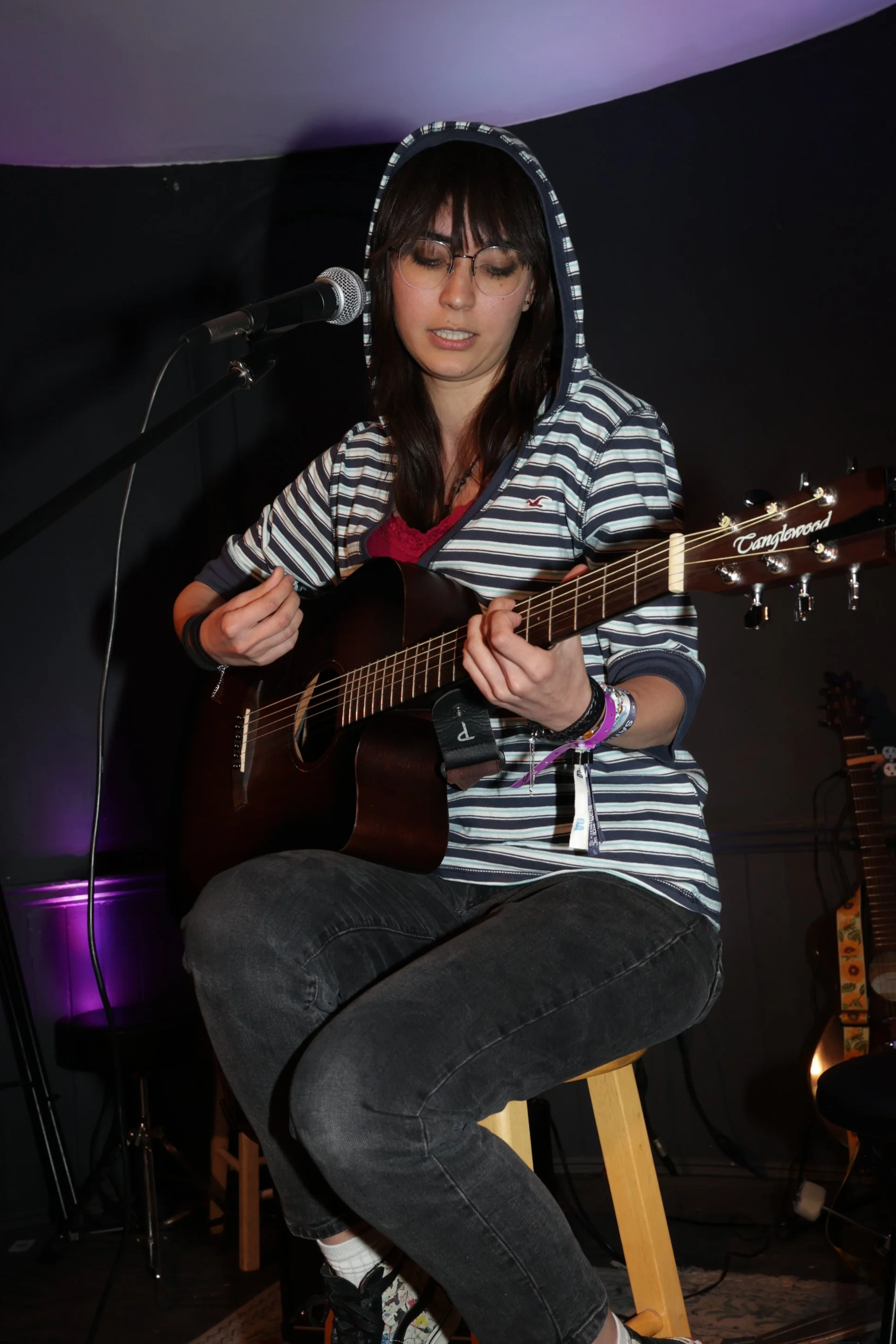
photo credit: Joaquin Irigoyen
by Catalina Irigoyen
At age 12, Kiara Nothhaft was enrolled in a small boarding school in Germany with classes of twelve kids or less, but she didn’t speak any German. The linguistic barrier between Nothhaft and the world around her led her to seek solace in the language of music.
Today, the Boston-based artist, producer, and live sound engineer’s debut EP “Scorpio Moon” is approaching its two-year anniversary, with forthcoming music videos to commemorate the occasion, a new EP on the way, and an album somewhere on the horizon. By fate, chance, or good timing, Nothhaft also scored a recording session at the same studio frequented by many artists she considers personal icons in her genre. She is on the up-and-up.
The songwriter experienced an international upbringing. Part Chinese, part Malaysian, and part German, she was raised across Hong Kong, China, and Germany. Eventually, her studies brought her to Boston, where she attended Berklee College of Music, graduating as a songwriting major with a minor in recording and production. “Scorpio Moon,” which debuted in 2024, is a collection of songs Nothhaft authored between ages 16 and 19. For the past several years, she has been active in the Boston music scene as a performing artist, as well as a collaborator and producer for other artists.
You've described yourself as a third culture kid who feels more culturally blank than fragmented. When did that sense of not belonging stop feeling like a wound and start feeling like a resource for your music?
They’ve gone hand in hand. I think a big moment for me was when I first did my cross-continent move, when I was 12. I moved from Shanghai to middle of nowhere in Germany. I was at the point where I was so culturally confused and couldn't talk to anyone. Then, I honed in on the music. It became this like huge source of inspiration.
I kept feeling culturally lost up until recently. I've been in Boston for so long and I've been around musicians from all over the country, and all over the world. Their hometown experience is the least interesting thing about them. At some point, I started honing in less on my identity, culturally, and more on my identity, period. I think that's when it stopped feeling like a wound, because I forgot about it.
Slowly, moving around became the least interesting thing about me. I finally made friends, started gigging more, and making more music. I was like, "This is the most interesting thing about me now. I don't have to use the third-culture-kid thing as a crutch.”
The third-culture-kid narrative often gets packaged into a recognizable, marketable thing. How do you resist flattening your experience into this label?
I've always had intense beef with being misunderstood. I'm an over explainer because of it. I felt like I was taken out of context my whole life to fit whatever narrative was most comfortable for people.
Now, it’s the year of the Wasian. There are so many more identities coming to the forefront of culture. I no longer feel like I have to heavily explain myself, because that specific identity is represented more often now—like with like Laufey, who is Icelandic and also Chinese, and Alyssa Liu, who is American and Chinese.
Seeing so many more identities represented, I feel like I don't have to fight that much anymore. One of the few things that I do have to keep reminding people of is that I'm still part Malaysian. Honestly, I kind of brush it off at this point, because I know who I am. I know who my mother is, who my father is, and I know my own lived experience.
As long as I just keep introducing my friends to the foods I've eaten as a kid, and they keep trying it, I feel like that's it—fighting to keep my culture alive by getting more in touch with everything I rejected as a kid. Now, I'm indulging in the food that I didn't eat because I was too picky. I started cooking so much Chinese food and Malaysian-inspired food. I'm trying to reintegrate myself, because I pushed all of it so far away when I was actually there.
When it comes to “Scorpio Moon,” does listening back feel like visiting a different person, or are you still her?
It does feel like I'm comforting an earlier version of me. I play “Icky Feelings” a lot, and every single time I play that one live, I truly feel like I'm holding the 17-year-old depressed me in my palms, petting her head, and saying, “It's going to be okay, you're going to be fine.”
Sometimes I sing and have visuals play in my head. I still have the exact same images flash to me as if I'm there, but it is more in a way that's honoring this younger version of me than feeling like I'm still her.
You have a lyric about turning to astrology for answers. Using a system that you don't fully believe in to make sense of things is a specific kind of angst—like you're looking everywhere for this thing that maybe can't be answered. What does that say about what you were actually looking for?
I was looking for some sense of either identity or direction. This was at a time where I was friends with someone who was really into astrology, and they made me get Co-Star. I didn't really understand it. I kind of got it for them, and I would send them my daily updates. I'd read them and think: "My day is going to make a little bit more sense because of the stars, because of something greater.” I was so lost, and it kind of gave me something to blame.
I used to be really into enneagrams, because not only did I not understand myself, I also didn't understand the world or people around me. It gave me a good way of being able to organize people. Throughout my whole life I've been a mediator—between my parents, or between my parents and brother, or between friends, or a teacher and a friend… I've always been in between trying to make sure people get along, and that was something that helped me make sense of the world at the time. Being like, “Oh, I'm a type nine, and that type naturally struggles with identity because they're doing so much mediation all the time.” That made a lot of sense. I’d found an identity through the fact that I had none.
You describe having “hear me out” moments—changing the direction of a song while working with Cameron Woody. What did it feel like to let go of your original idea and take those leaps?
It was quite stressful at first, because I had been holding on to a lot of those songs for a while—it had been three years since I wrote the first one. And also, my fear of being misunderstood. But because I was so comfortable around Cam, it got easier with time.
It was a really uncomfortable feeling—we had this discussion about “Icky Feelings.” It's such a small, inconsequential change, but I had the bridge starting on a certain chord progression, and Cam was like, “I think this slows down the song. Can we instead start it on the ending chord progression of your chorus?” Because I had that song for so long and it was so precious to me, I got uncomfortable with that, and said I’d think about it.
But then, I played it more, and I trusted Cam—she was right, and after I got over that first hurdle of being given constructive feedback, it was the thing that broke the ice. All of a sudden, everything was fair game. We were playing around with sounds. Now, I can't imagine working any other way. I have to work with a producer to bounce these ideas off someone, because there's so much in there that I love that I would not have come up with on my own.
Do you see yourself as part of the Gen Z female-led resurgence of 2000s pop-punk or are you figuring out where you stand in relation to it?
To be honest, I haven’t really thought about it much—and that makes me happy. Because I used to overthink too much, and trap myself in a corner. Now, I'm listening to music, going to shows, taking the things I like, and using them. I no longer think that deeply about it, and it's been very freeing.
I'm not concerned with being different. Or even the opposite of that—filling this trend and riding that wave. I get excited when I find an artist that I feel like I could have written something very adjacent to.
Can you tell us about your choice to layer guitars and voices?
I'm not an insane guitarist, but paying attention to how those things are layered became very pivotal to the sound I created for myself. I’ll play a song, and then I’m like, “Okay, I need another layer.” And it'll all stack up. I think that it adds so much sparkle and bounce! I’m also inspired by minimalism a lot, with how simple motifs are layered and manipulated over time.
Your work appears to be rooted in the acoustic singer-songwriter tradition. How much of your sound is an expression of your core, versus the constraints you were working with at its inception?
I think all of my writing—at least up until the past couple of months—has stayed true to the singer-songwriter tradition, in that the song has to be good on its own, as just a voice and guitar. If it has nothing else besides that, it has to have really solid legs. You need to be able to move someone with just that.
I followed that mindset and kept it up this entire time, even though I know my sound has more options now and I've expanded. The core songwriting of it, I think, is still the same in that I need to be able to play it alone and have it still work. Being at Berklee and taking so many songwriting classes really drilled that in for me.
Lately, because I put a band together, I’m having so much fun playing, and I've been going to a lot more rock shows, I’ve realized there's so much more that you can do that you can't necessarily accomplish on your own. There's so much more I can do now that I have a really good guitarist who can do things that I can't do. But I would say the core of my melody writing, the structures I pick, and the general form of everything has still stayed true to the singer-songwriter tradition of being able to play it alone and have it still hold up just as effectively, not relying on the embellishments.
Who is the listener you're trying to reach, and what do you hope they get from your music?
I recently said this at a show as a spur-of-the-moment thing while I was tuning: “Hi, I'm Kiara, and I make music for losers.” I think the person I'm trying to reach is someone who feels like there is something deeply wrong with them—there's an angst in there that they are afraid to name. I have a set of songs that's like, what if I were me, but worse? It’s me tapping into a feeling I have and being like, if I was the worst version of this feeling, what would I say?
Tapping into the things that you're afraid to think and say gives so much room to play. If I have a concerning thought, I’m obviously not gonna act upon it. But I still allow myself to entertain it. What you do with it, that's what determines who you are. I'm reaching out to the type of person who has impulsive thoughts about things, and they are a bit afraid of themselves. I’m trying to say, “Listen. Sometimes, this happens. And you can turn it into art.” You're still going to walk around, like a normal person, and be the best person you can be. It's cathartic, and I think that's beautiful.
I recently wrote one of my favorite songs to play right now, which I don't think this is going to be on the next EP, but it will probably be on the album I make after that—it’s called “Disgusting.” I call it my cute aggression song. It's like, what if you saw someone so hot that it makes you so mad that you want to kill them? Like, you want to torture them. You’re obviously not gonna do that! But also, wouldn’t it be really funny if I amputated all your limbs and stitched your skin onto me, because that means you can't leave? I get to look at you all the time. It's just fun.
What is the scoop on your upcoming projects? What’s tickling your brain, and how will you explore it?
I am recording four music videos this summer, because the two-year anniversary of “Scorpio Moon” is coming up in the middle of July, and I realized I had no visuals at all. When I first put the EP out, I was playing with the idea of little visualizers or lyric videos. I didn't really know how to execute it, and then it felt like it was too late. I think eventually I kind of grew the fuck up and realized it's not too late. You can make things whenever you want to make them.
I'm excited for this project because I'm working with a bunch of Emerson film students and film graduates. An Emerson film professor reached out to me because he was creating this roster of Boston-based artists for a music video class’s end-of-year project. When I came up with this idea of potentially doing like a two-year anniversary celebration, I decided I’d ask him for help. He was like, “You know what would be really awesome? If it’s fine with you, I want to involve my students.” I get to meet peers and form more connections. He truly believes in them and wants to help jumpstart their careers, and I think that's beautiful. Plus—the more the merrier!
The next project is my second EP. I knew I wanted to work with my producer, and we're gonna be recording it in July. I'm going down to North Carolina, where she's just moved back to. For a lot of the artists that I rediscovered recently in my genre, I did a deep dive on who their producers are, and a lot of them were the same guy. And we’re recording in his studio!
I didn't realize that my producer had interned there. It was a crazy set of circumstances that lined up. If fate is a thing, then this makes me believe in it a lot.
Is there anything you can share about the second EP?
It feels like a good stepping stone between the first one and the album that I want to make after that. I feel like I found myself within like the past year and a half, figured out who I am as a person, but also as an artist. It's just a collection of songs that I wrote that are still really good, and I'm still proud of, but don't necessarily fit the theme of what I think the album is going to be.
What is your advice for new and emerging artists and what resource do you wish more people knew about?
Be the audience member that you want to have, and engage with your local scene. Because I was afraid to go to my friends’ shows, the shows of bands they played with. I was afraid of looking like a fan of things and not a peer. But then, I missed out on the incredible experience of being in a scene, and the beauty of knowing everyone that's playing, because you're tapped in.
Some of my favorite artists are my friends. I love when my friends come to my shows and they're singing along. That makes me so happy. And I love going to my friends’ shows and singing along. You build this beautiful community, you go to each other's shows, you promote each other, and have the best time creating and sharing spaces with other musicians. Not only are you networking really well, but your life becomes richer. You start making better music.
On your website, your music is described as an intrusive thought covered in paper butterflies and glitter glue. What’s the intrusive thought?
It's anything. It's the thought you're afraid to say, but the thought you're also afraid to think. Finding that darkness within you and grabbing onto it. Creating something that hones into the fullness of that thought and not being afraid, because then, in a way, you’ve de-escalated it. You’ve given it its moment to simmer and sit.
You take the thought that you're afraid of, build a world around it, and you tie it off with a bow. Isn’t that fun? Now, it's this pretty little thought that no longer bothers me. That’s the epitome of my music: this is me, but worse. But I'm going to keep trying to be me, but better.
